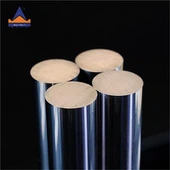
Characteristics of Hard Alloy Materials
Hard alloy has high hardness, and the hardness can reach 85-95HRA at room temperature. High thermal hardness, up to 900~1000 ℃. Good wear resistance, capable of cutting hard materials around 50HRC; The compressive strength is high, and the compressive strength of cemented carbide can reach 4510MPa, but the Flexural strength is low and the brittleness is high. The impact toughness of hard alloys is very low, but it increases with the increase of cobalt content and WC grain size in the hard alloy; Good corrosion resistance and oxidation resistance; The low coefficient of linear expansion and poor thermal conductivity are conducive to the welding of hard alloys with steel. The density is generally between 6.0 and 16.0g/cm3, and the chemical composition and grade of the hard alloy can be determined based on its density.
Due to its high hardness and difficulty in processing, hard alloy materials can only be processed using special methods such as electric machining (such as electric discharge, wire cutting, electrolytic grinding, etc.) or grinding wheels. And generally, hard alloy parts are brazed, bonded, or mechanically clamped onto molds, and high hardness hard alloy cutting tools and diamond grinding tools are used for cutting and grinding. Therefore, only small and simple mold parts or inserts can be manufactured, without the need for heat treatment. So, there are no changes in size and hardness of the processed molds. If used improperly, it will cause serious waste.
The more carbide content and the less cobalt content in hard alloys, the higher the hardness, thermal hardness, and wear resistance of the alloy, but the lower the strength and toughness. Some alloys are suitable for processing brittle materials, while others are suitable for processing plastic materials. Among similar alloys, those with high cobalt content are suitable for rough machining, while those with low cobalt content are suitable for precision machining.
Hard alloys can be used to manufacture cold working molds, such as cold drawing molds, cold stamping molds, cold extrusion molds, cold heading molds, and precision rolling rolls.
Characteristics of Hard Alloy Materials
Jun 08, 2023
Leave a message
You Might Also Like